Friday, July 23, 2010

Titicaca joke goes here

After La Paz, our next leg of the trip was to spend some time at lake Titicaca. Titicaca is the lake that overflows yearly into lake Poopó, but you´re not allowed to make any jokes about that. It was a very serious job going to our next destination, Copacabana. Since Copacabana is on a penninsula that belongs to Bolivia but is surrounded by Peru, the bus you take from Bolivia has to cross a straight by, um, a ferry, kind of. They mentioned something to us about needing an extra B$1.5 in addition to our bus ticket, so we were expecting something unusual, but it was quite the show, and our 3 hour bus ride turned into an 8 hour bus ride due to the switcharoo at the ferry and some bad weather. The bus was parked at the ferry without any instruction as to what would happen. For the first hour or so, the people on the bus started to get fidgety and some decided to get out and use the bathroom, only to find we had been abandoned in our bus, in a sea of busses, locked in! Someone pounded on the doors for a few minutes until someone outside let us out. We all got out and found that hundreds of busses were waiting to cross but were delayed due to high waves and wind. We hung around in the town for a few hours watching these barges in disbelief that they´d manage to get any busses on them and across the straight. I also got the most amazing fried trout from a street vendor while waiting. Eventually, the waves settled down and the busses started to cross, and it happened surprisingly quickly:
After the busses started crossing, a huge line then appeared in front of the people ferry, which was just a couple of these little tiny 10-man boats that they´d squeeze about 20 people on to. The busses were crossing faster than the people, and we were at the end of the line, so we got to watch our buss cross in front of us, and we started to wonder how they´d figure out how to get all of us back on the bus. So when we did eventually get across, quite a bit later than our bus, we couldn´t find our bus, and we started to wonder how long exactly our bus would wait for us, since we had no instructions when we had gotten off many hours before. Well, we searched for a while and couldn´t see it, so we started following a long line of people walking up this hill, thinking that maybe there was a parking lot up there where the busses wait, but after 15 minutes of that or so (and completely out of breath because we´re at some 13,000 feet in altitude) we started to see the people disperse, so we headed back down the hill, dazed, figuring we had missed our bus (with all our luggage). Just then, our bus came chugging up the hill, we waved it down and jumped in. Things often have a funny way of working out around here, but we did notice two empty seats on the bus that weren´t there earlier, so we thought that maybe there were a few other tourists less lucky than us. When the bus dropped us off at Copacabana, 4 hours late, it headed straight back to La Paz, so I still wonder what would have happened to our luggage if we hadn´t been lucky.

Copacabana was beautiful! It´s definitely a tourist town, but it was relatively quiet and tranquil when we were there. Apparently there are lots of festivals where it explodes in population for a few days at a time, but for us that meant lots of open hotel rooms. We plopped our stuff down in a room and started exploring town. There´s a very steep hill above town, called the Calvary hill or something like that, which has little monuments all the way up representing the different stages of the crucifixion of Jesus. It´s a vertigo-inducing path, but each cross is placed at an elevation that you can just barely make it without fainting from lack of oxygen, so you get these breaks all the way up. There were lots of crosses and shrines at the top and an amazing view of Copacabana:

Back in the town there is an impressive cathederal with a moorish or ottoman-style architecture (with a middle-eastern appearance), and we saw all these cars covered with flowers. We figured there was some special occasion there. Then we saw cars, trucks, busses, every vehicle you could imagine covered with flowers and we started to wonder. Kate then remembered that the cathederal in Copacabana was well known for blessing cars. People come from all over to get their cars blessed. We stopped and watched the priests bless cars with flowers and champaigne, and saw all the vendors along the front sell flowers and saints and trinkets to trick out your car christian style:
Quick note about the showers in Latin America, to clarify an earlier comment about getting shocked. Many of them operate on hot water on demand, but the heater is in the shower head and so it´s somewhat disconcerting to see 240V cable running into your shower head above you. But then you realize it´s well grounded, so it should be safe. Oh, wait, what´s that green wire sticking out of the shower, not connected to anything? Oh, it´s the ground not connected, which leaves the pipe as the only ground, which you have to touch when you touch the metal handle, which is why it is common to get shocked. Now, I have made a habit now of using a dry shirt to adjust the handle while showering, and I try to remind myself that thousands of people seem to survive here in the showers, but I still don´t really like it. This picture doesn´t show it, but our hotel had graciously wrapped the shower handle with red electric tape. A funny solution when I keep wondering why they don´t just wire it up correctly in the first place. But then I guess that´s what you get for the equivalent of ten bucks a night. Otherwise the hotel was beautiful, so I can´t complain too much.

One more goofy interlude here. We´ve taken thousands of pictures of dogs over here, which seem to cover the southern continent, but we´ve spared you from most of the pictures. Many of them like to wear sweaters because it is so cold up in the Andes. Kate saw this one and thought that we had to post this because it was just a little too crazy. He certainly would fit into Kentucky well:

OK, next stop was Isla del Sol, or Island of the sun, where the Incans believed the sun was born. It was a beautiful island with some amazing Incan ruins on it. The first ruins we saw were called the labrynth. It didn´t look like much from the front, but once you got in, you could wind from room to room for hours in what really did look like and feel like a labrynth:
We had been dropped off on the north end of the island and we had all day to get to where the hotels are on the south end (and where our return boat tickets were), and we certainly needed all day. It was a beautiful but somewhat grueling 10 kilometers or so. It normally wouldn´t have been so difficult, but climing those islands was really difficult at that altitude. You´d see really strong, earthy looking hikers climbing relatively moderate hills at a geriatric pace. So yes, the scenery literally was breathtaking:

(sorry really cool picture of the ridge trail got deleted by the dumb computer)
Ok, I admit, there were some cute kids along the way that I paid to get a picture taken with their Llama:

Another Incan ruin along the way with the Cordillera Real mountains in the background:
And there were donkeys everywhere when we got to the town on the south side. It turns out the town is built into a really steep hill and since there are no cars, all the goods, materials, food and water are carried up to the down by donkey.
We went out that evening for a dinner at a restaurant on the ridge and watched the sunset from there:
Ok, now let´s fast forward a little (it´s also getting late and we need to get dinner and a bus tonight, so I need to start being more concise). We returned safely to Copacabana, and after Copacabana, we bussed down to Arequipa in Peru. We paid a little extra for a bus that had a guide who helped us cross the border and change busses, which was very nice since it all happened quickly. It was a relief to come back down to a more reasonable altitude in Arequipa, which is nestled between some volcanoes just below the Altiplano. Here is the sunset at our hotel we arrived at in Arequipa, with a view of El Misti in the background:
Arequipa is known for it´s beautiful architecture made out of white volcanic stone. For a little extra money, but still way less than a cheap dinner at home, you can get a nice dinner with a view of the plaza and cathederal from your seat. Notice we are not bundled up in heavy jackets anymore. That´s because we´re back down to 8,000 feet elevation or so, which makes for beautiful days again and cool nights like in Sucre.
And finally, one more picture of the plaza at nighttime from where we had dinner last night:
We´ll have more stories to come about Arequipa, but we have a night bus tonight in a few hours to Nazca. We´re hoping to see the famous Nazca lines tomorrow, and then head to the resort oasis of Huacachina for a few days of chilling out, sandboarding, and wineries. Then we return back to our hotel in Arequipa for a few more days. We´ve left all our big luggage here since we won´t need the heavy clothes down near the shore where we´re heading, so we have to return here on our way back to Cusco. Hasta Luego!

(by the way, this was posted by jeff, not kate as it states below)

Saturday, July 17, 2010

Last day in La Paz

We stuck around La Paz today, since Jeff is coming down with the cold I gave him, we needed to do laundry, and we wanted to check out the Valle de la Luna (Valley of the Moon). It was a pretty relaxing day, over all. The morning was extremely lazy, so the day really started with lunch:

Lunch was as good as it looked. It was very expensive for Bolivia - B150, but that included the meals you see, plus two juices each and a dessert. But then, if you convert that, it totaled US $21 or so. Another reason I love Bolivia. Did I mention it was in a greenhouse in a garden?

Next, we went to Valley of the Moon. We took local transportation, trufis (like Tanzanian daladalas) to get there and back, since it was about 10 km outside of town. We weren´t expecting a whole lot, since the guide book says it´s over-hyped and others say there isn´t much there. So what we got far exceeded expectations.


It´s a good thing it´s a park and they´ve built paths through - you´d never get anywhere without them:


The weather was a bit dark and grey and rainy, but it made for good photography lighting.


Staying on the path was a must, since there were some very large holes. Some, we couldn´t see the bottom of.


There was a small, colorful town just past it that made a pretty good backdrop.


Back to La Paz - the trufi we got back wasn´t exactly the one we wanted, since the one we wanted seemed to be too popular a route to leave room for us in any of the vehicles going by. So we grabbed another that let us off in a not-too-far-off part of town, and wandered through a market that seemed to go for dozens of blocks.


And there you are. We´re off to pack for Copacabana tomorrow. We´ll check in someday, but not real soon.

Big updates!

Hello all,

We´ve been out of internet contact for about a week now, and we´ve finally updated this thing with all the happenings from the time away. Just so it´s not too confusing, the last four posts go together, and show up on the blog in reverse chronological order - so scroll down to"Pictures of Sucre and Potosí" first, then go back up to "Uyuni part 1," then "Uyuni part 2," and finally "La Paz."

Also, we put up a couple goofy videos from Uyuni:
The biggest bottle of beer in the world: http://www.youtube.com/watch?v=fc2KslJBnBg
Me dancing on Jeff´s stomach: http://www.youtube.com/watch?v=he1Waeh0pzw

Enjoy! We´ll be out of contact for a while again, we suspect, so don´t worry if you don´t hear much.

-Kate (and Jeff)

Friday, July 16, 2010

La Paz

After Uyuni, we took the overnight train to Oruro, which is sort of the in-between stop between Uyuni and La Paz. Our friend Anna joined us, who was on the Uyuni trip with us, and happend to be going in the same direction. The train was nice because it was a lot easier on the nerves than a bus over bumpy dirt roads for 10 hours. Then we took a bus to La Paz that went much faster over paved roads. Took about 12 hours overall. We tried to get a hostel that doubled as a brew pub next to the train station, but it was full, as our travel book warned us would happen. Instead, we got a hostel on the main road that looks a little scary from the outside--sitting between a couple hardware stores with peeling stucco walls is a corrugated orange door that leads to our hostel. As seems to be the case of many hostels and hotels in Latin America, the insides can be surprisingly nice compared to the outsides, and this one is a little oasis here in the city with sunrooms, fast internet, a kitchenette, and friendly staff. The bathrooms are shared and the electrically-heated showers not quite wired right, which gets you shocked (also unfortunately common in Latin America) if you touch metal while showering. But not bad for the equivalent of $10 per person a night.

So we dropped all our stuff off at the hostel and headed out into town to get lunch and stretch our legs. Right next to where we had lunch, we found out the famous "witch market" was just down the street, so we had to pay a visit. There are lots of scenes like this, with ladies selling thousands of little charms and talismans for whatever might ail you:
Of course, it's hard to pay a visit to the witch market without noticing the mummified llama fetuses everywhere. Apparently it's a good luck thing to bury them in the foundation of your house, and certainly there are other great uses for mummified llama fetuses, but for us they were just interesting eye candy. I promised to bring some back home as gifts, but I'm afraid I'll have trouble in Customs, so hopefully the pictures will have to suffice. I had a few more graphic pictures, but I was encouraged to go with a more friendly one, which includes them in all shapes and sizes:
On our way back, we saw that the streets were closed and there were thousands of police and military people everywhere. We finally learned that we had arrived the evening before July 16, which is a type of indepencence day for La Paz--actually it's the day they declared war to get independence from Spain, but it was a huge celebration. Did I mention our hostel was on the main road? Well, by evening it had become the staging ground for parades that would last for at least 24 hours. This is the view from our hostel of the streets below:
After a loud night, we got up early to see Anna off to Copacabana and to catch our tour bus to Tiahuanaco, a small town about 50 miles from La Paz where one of the oldest ruins of early american civilizations can be found. Of course, the folks of Tiahuanaco were also partying and parading through town, fully dressed up in their traditional clothes:
Even on normal days, you see a lot of the native women here in their shawls, fancy skirts, and bowler hats. Often they have a bright woven blanket with a baby or other stuff inside. Arond Sucre, the hats seemed to be shorter with a wider brim, but the women around La Paz wear a tall bowler hat with a short upturned brim. Here were a couple women walking by to watch the parade: Tiahuanaco was a big site with lots of interesting ruins in different stages of restoration. The biggest part was a sort of step pyramid-like structure that was used as an observatory:
The most famous part of the ruins was the sun gate. The tiahuanacos worshiped the sun, which is represented by the carved guy in the middle, surrounded by I believe 48 figures representing the weeks in their calendar:
There was a temple dug into the ground that had over 700 carved heads built into the wall, each representing important people or animals. There was even an alien head (not shown here), that had some people confused for a while. The underground portion was also a nice break from this frigid wind that was blasting us with dust throughout the whole tour:
Kate posed in front of the main gate to one of the temples, showing just how bundled up we were. This is also the gate where Evo Morales, the current Bolivian president, was inagurated. He is their first native president and has done a lot to advocate for native tribes and cultural heritage in the country, although there are a lot of strong opinions on both sides about him. They kept the largest monolithic statue of a priest in an indoor museum near the archeological site. It was probably 20-30 feet tall and fairly tastefully set up in a room to itself with aesthetic lighting. Of course, the tour guide told us later that we weren't supposed to take pictures of it, but it was way too late by the time we got the news. It was the last stop before having lunch and heading back to La Paz.
On the way back to La Paz, you pass through El Alto, which is appropriately named because it is extremely high elevation (it's where the airport was that I flew into, where almost everybody gets altitude sickness upon arriving), along the highest point of the Altiplano. The edge of El Alto breaks downward into a steep bowl where La Paz is located, so as you descend into the bowl, you get amazing views of La Paz with its surrounding mountains. You also see the houses that are precariously stacked up the hillside, just waiting for a mudslide to carry them away. I'm not sure if this picture does justice to the size and dizzying depth of the city, but it was about the best we could do. You can also see the glacier-capped mount Illimani in the background, which is over 21,000 feet in elevation, so it still towers above the 14,000 foot Altiplano and La Paz just below: We went back into town for a walk to see the town plaza and get a cup of coffee. Parades were still going on, so we watched what appeared to be a memorial service parade and then hung around the square and watched the kids play: I wasn't feeling so well, as I think I caught Kate's cold, and had some food that didn't sit so well the day before, so we decided to stay an extra day and take it easy and maybe see the Valle de la Luna. So it's our second full day in La Paz right now, we just finished a great breakfast in the Plaza with a salteñas and
an omlette, and we're continuing to update our internet stuff before lunch and hopefully an afternoon trip. We also brought 22 pounds of dirty clothes to the laundry service that should be ready tonight. Our plan is to continue on to Copacabana tomorrow. It's a little quiet town on the edge of Lake Titicaca, from which we hope to embark on a one or two day trip to the Isla del Sol, an island in the lake that is supposed to have some nice ruins and be a little less touristy than some of the other Titicaca tours. There are some famous floating islands (manmade out of reeds) that are apparently quite the tourist trap, and a more of an artificial remake of the historic lake people, so we will probably avoid that. After that, we're on the border of Peru, and we're hoping to head down toward the coast to see some monster sand dunes, oases, and other interesting stuff. Don't know the next time we'll be able to get pictures updated, but we'll try to keep in touch occasionally. Hasta luego!

Uyuni, Part 2: Gettin´ High

No drugs were involved in the adventure that inspired this post. We just went to very high altitudes.

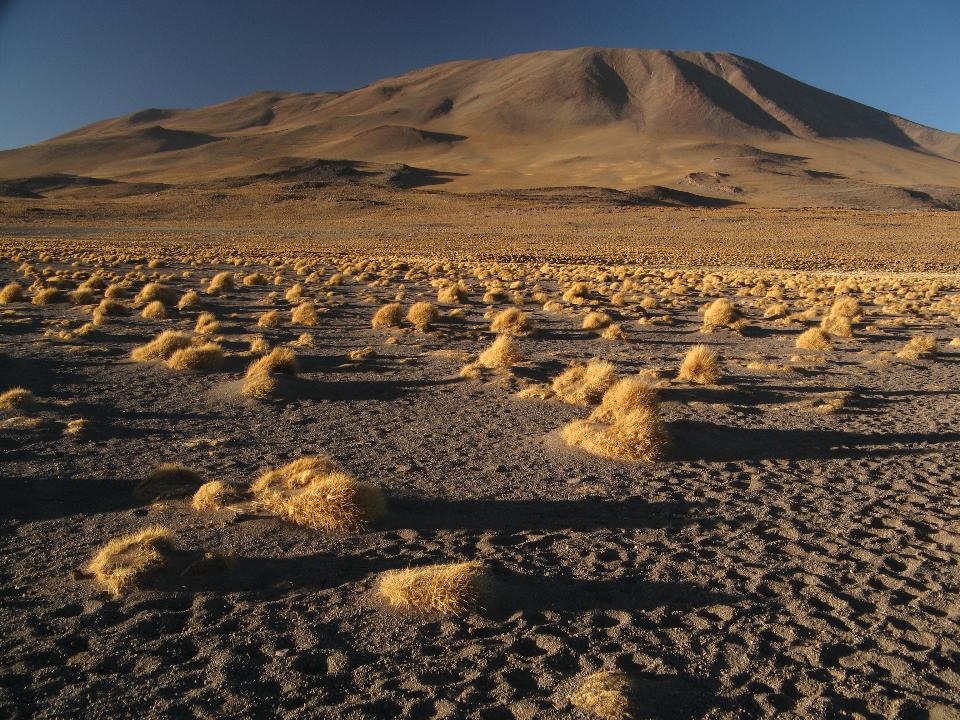
Day two of the Uyuni Salt Flat tour: we were done with the salt flats, and on to the other strange geology of the area. We got to see lots of mountains on the drive, which were deceptively small-looking, considering that they reached a minimum of about 15,000 feet, and up to over 18,000 feet. The trick was that we were looking at them from an altitude of 12,000 to 14,000 feet. Being out of breath all the time helped us remember that these are, in fact, high mountains.


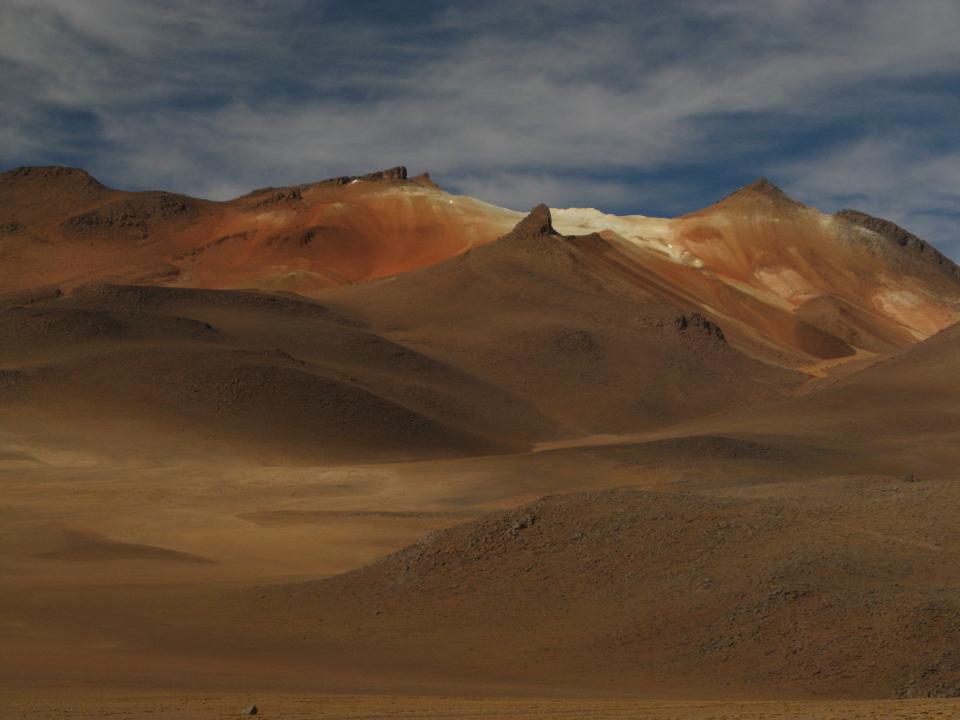
Some of the mountains had interesting colors on them. The guide kept saying that the colors were due to minerals, but that the mountains were not geologically active (except one or two), but I have the feeling that he meant that they weren´t puffing smoke. I think they are active on a geologic timescale, or they wouldn´t be the pretty colors they were.


Along the way, there were some very interesting rock formations, including the Tree of Stone:


This day was mostly driving from lagoon to lagoon. I believe this one is Laguna Hedionda:


These lagunas were famous for their flamingos, which put up with cold temperatures. It´s the dry season now, though, so there weren´t a lot of flamingos, but there were still a few:


Laguna Colorado was where we spent the third night. It was extremely cold, being at 14,000 feet, but it had a great view and a pretty sunset:


The bottom of that sign says altitude 4278 meters, which is just over 14,000 feet. Cozy place for a night´s stay. Should I mention that the hotels here don´t have heating?


There were vicuñas there, too, which are the wild relative of the alpaca. Anna got pretty close, and they didn´t run - we were joking that the people running the hotel we were at had put out vicuña food, since it didn´t look like there was anything else to eat out there.


We had a great dinner that night, with a surprise bottle of wine. Alcohol at these altitudes meant that one bottle for four people (the fifth didn´t drink) was more than enough.


I forgot to mention in the last post that our abandoned hotel the first night made for good stargazing. We decided that we needed to go out again at Laguna Colorada, since we were up even higher in elevation, so we could see even more stars. Had I mentioned that it was cold, though? Yup.


The stars were absolutely incredible from up there. We saw southern stars that we´re not used to, of course, including the southern cross, Centaurus, and the Magellenic Clouds peeking over the horizon. The Milky Way was unbelievable - the dark dust lanes were so distinct. Anyway, enough geeking. It was also very cold, so we didn´t stay out long. Anna was a champ, joining us both nights, even though she hadn´t started off an astronomy geek.

The next morning, we got up early (about 5:30) in the cold (did I mention that it was cold?) to see the geysers doing their thing. The geysers are at just over 5000 meters, which means we were over 16,500 feet. We certainly felt it. But they were neat looking:


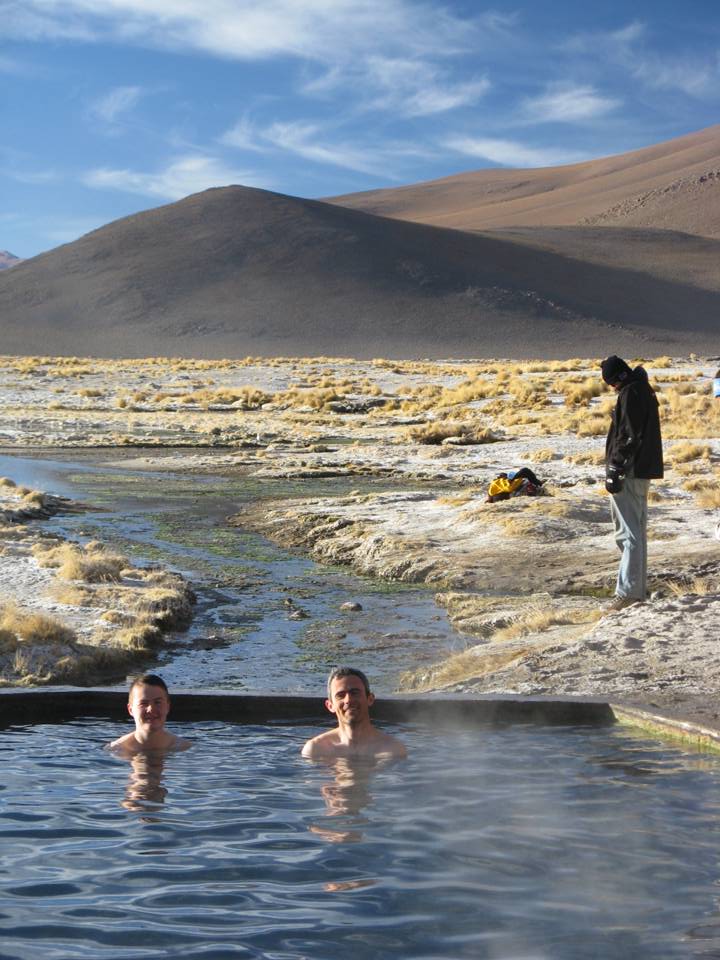
Our next stop was a hot spring that had a hot-tub area for the hundreds of tourists it saw in a day. Jeff, Anna, and Michael were crazy enough to go in (Michael not pictured):


While the rest of us with sense (Shahar, Albarosa, and me) stayed bundled and just put our feet in:


We also stopped by another laguna, Laguna Verde:


And then, we were on our way back, with a couple more stops planned. We stopped in the "city of rocks" for lunch, which is a huge rock formation of eroded lava rocks. Someday, I´d love to go backpacking there - it was incredible. There was a little town nearby that had the tail of a small plane on top of one of the rocks, where someone had crash landed in the snow a few years ago. Apparently, everyone survived, or so said our guide.

We were also supposed to stop in an "authentic pueblo" and at a "train cemetary," where old trains are left to rust, on our way back. The car, however, had other ideas. As we were driving along a long, flat stretch, it looked like we hit a water balloon, and then dirty water was raining down on the windshield. As it turned out, the radiator pump (or something of the sort - I know very little about cars) had blown, probably because it had been filled with water, not with radiator fluid. The great thing about being a tourist on a heavily-touristed area in a country with a cooperative culture is that all the other cars that passed us stopped to help. They crammed us in one by one to bring us back to Uyuni, leaving our poor guide and cook to sort out the car trouble. Jeff and I got to ride together, and ended up in the front seat of an old Suburban-style vehicle. The group was a Bolivian family out for a tour of the salt flats, but of course, the locals don´t go with the gringo tourism agencies. So our older car was decorated with little charms including bowler hats (the ladies here wear them a lot), pan pipes, and even a fake US $100 bill. It was a big car, but it was a big family, too, so we were rather squeezed. But at least we weren´t stuck on the side of the road! On our way home, we saw two other newer Land Rovers, like the one we had been riding in, broken down - so cheers to old Suburbans.

When we got back to the little town of Uyuni, we were actually pretty happy to see the place. It´s not much, but it has interesting statues:


It also has a train station, and a train that goes north, but leaves at midnight. The road out of Uyuni heading north is apparently pretty awful, so we caught the train instead. We even splurged on first class seats, which cost 101 bolivianos, equivalent to just over US $14. It was worth it - we could almost lay flat, except for putting our feet up. The train took us to Oruro, where we then caught a bus to La Paz, and that is where we are now. Jeff gets to explain that part, though.

Uyuni, Part 1: Tourism, Bolivia-style.

Jeff may have been short on text in the last post (posted a couple minutes ago - if you haven´t read it, scroll down first!), but I´m not promising the same...

Our next big adventure was to go to the Uyuni Salt Flats (Salar de Uyuni), the biggest salt flats in the world. They´re so flat, they´re used to calibrate satellites´ altitude measurements. That´s flat. But to get there, we needed to get a tour put together. That turned out to be quite the adventure...

We took a bumpy bus from Potosí to the small town of Uyuni. I expected to be bombarded, Tanzania-style, when we got off the bus by people trying to sell us tours and so on, but we were only approached by a couple people, and they were not terribly pushy. This is one reason why I love Bolivia. We got a hotel room, dumped our stuff, and headed out to talk to several agencies before choosing one.

I had collected tons of advice on how to book a tour, including stuff about not visiting certain things because they´re ecologically unsound, asking to go the opposite direction from the usual tour loop to avoid crowds, and checking out the cars before booking to see that they look mechanically sound. All the advice was worth about junk. Every tour agency does exactly the same tour, and with only two of us together in a car of six or seven passengers, we couldn´t make a lot of requests like which way to go. The main ecologically unsound site, a hotel made of salt that has bad water treatment and was polluting the salt flats, is no longer running as a hotel. It has converted to being a museum because of the pressure put on the government by environmentalists about it. (Incidentally, the museum/ex-hotel was closed when we visited - total moot point. So glad we wasted the effort of asking the tour agencies about it.) All of the cars are kept somewhere besides the agency, so we couldn´t see them. Even if we had, it wouldn´t have helped - they all look new, since the salt flats (and the drivers, I might add) do so much damage to cars that the engines don´t last long.

At some point, we got tired of going from place to place and getting exactly the same information, so we just booked a tour at the place we happened to be at. The tour included a night in a (non-polluting) salt hotel for the first of the two nights, a Spanish-speaking guide in our car and an English-speaking guide in a car that would accompany us, two English people and one Irish person as our fellow travelers to fill the car, etc. By the time we booked the tour, we had met another traveler, Anna, trying to do the same thing as us, so we all booked together. We went and had dinner, then crashed early, safe in the knowledge that it was all taken care of.

The next morning, we got to the crazy business of getting train tickets, getting snacks, getting lots of last minute things that take forever in Bolivia. But we made it into our car, and met our fellow travelers - an Italian woman, Albarosa, and an Israeli couple, Michael and Shahar. We were a little surprised, having been told we´d be with English and Irish people, and they were also suprised, having been told to expect Dutch people in their car. But we brushed it off - just a shift of cars, that´s all.

When our car took off, we were not accompanied by another car. The English-speaking guide was not part of the deal anymore, apparently. Oh well, I need to work on my Spanish, so I didn´t figure that was an extra that I cared about. Our guide, Freddy, and his wife/our cook, Elizabet, were very friendly and extremely helpful. We took off for the salt flats for our first day of travel - and it was incredible.

The closed museum/ex-hotel was one of the first stops. Because it was closed, it was fairly quick, but it had an interesting collection of flags that made it seem a little like we were at the south pole. Funnily enough, the US flag (ours), the British flag (Anna´s), and the Italian flag (Albarosa´s) were missing, but the Israeli flag was there. The Ayamara flag, an indigenous group in Bolivia, was flying high, so we adopted it:


Next stop, an island in the salt flats. The Andes are very dry, so there are a lot of cactuses here:


Next to the part that anyone who knows anyone who´s been to the salt flats has heard about, or seen pictures of. The salt flats are really flat. -How flat are they?- They´re so flat, they mess with perspective!

Sorry, that flopped. But the pictures didn´t:


That last one makes us look like atheletes. But we only cleared maybe a foot off the ground - trick photography, done like this:


For most of the time in the salt flats, this is what we saw:


Finally, we got out of the salt flats and off to our hotel. We were interested to find out what the inside of a salt hotel looked like, since the museum/ex-hotel we toured had been closed. We never got to find out, though - we were dropped off at this place:


You can tell we´re thrilled. Them´s mud bricks, not salt bricks. When we got there, it was totally abandoned, as far as we could tell. Freddy, the guide and driver, dropped five of us and his wife here, and took Albarosa to another hotel. This is when we realized that we had been shifted to another company from the one we had booked with, and that all bets were off. Even worse, Albarosa had booked her tour for a much higher price than ours (we never asked how much, but her hotels were much fancier than ours, and she was shocked that six people plus the guide and cook were being crammed in the car, so we´re guessing it was a -lot- more than what we paid), and all she got for the extra expense was nicer hotels and earlier waking times, since she had to be picked up before us both mornings. Ah, unregulated tourism...

But at least she got a decent hotel. Ours was so crappy, no one else ever showed up except the owner, who was kind enough to turn on the electrical generator for a few hours. We were all a little put out by the situation, but we slept there anyway. It made for a lot of jokes, actually. And we got to know each other very well...

I´ll write more later (yes, it´s possible to write more - succinct, I ain´t) about days two and three. I´m signing off for the evening now, though. Cliffhanger!