Monday, February 27, 2012

Adventures of Jeff and Kate... AND FAWN!

The itinerary of Fawn's trip included a couple nights in Esteli (see the previous post), a stop back through Managua, a couple nights in El Jocote to do one of our work projects, another stop through Managua, and a trip to Ometepe Island for five nights with a stop by Masaya for shopping in the tourist market, then back to Managua to let Fawn fly away. There was supposed to be an adventure trip down Canon de Somoto in there, but silly me went and fractured my ankle and canceled that part. But being in the walking boot helped me get around the rest, so game on!

The trip to El Jocote was one that Fawn was especially interested in, since she's a village girl herself but has been stuck in Orange County for the last several years. She wanted rural, we gave her rural. First, we loaded up the work truck, and in Nicaraguan fashion, made her ride in the back.
Note the tied-up tailgate - it doesn't close right. Peter? Mitzi? Don't worry - she survived.

We went on all the types of roads possible in Nicaragua - nice highways (although Nicaraguan traffic will slow you down no matter the road):
Fairly nice highways:
Pretty good dirt roads:
Not great dirt roads:
Dirt roads that disappear into watering holes:
Really awful dirt roads:
And really awful and really steep dirt roads:
But when we arrived in El Jocote, we were greeted by the weekly baseball game:
and got a few hitchhikers we knew to keep Fawn company in the back of the truck for the last little bit of the trip:

There was work to do, of course. The work was mostly an excuse for getting up to El Jocote - since my accident, I haven't been able to go by bus, since the last 3 km are a fairly rough walk. The only way I can get there is by 4wd truck, and that means taking the work truck - which means working. So.

The project was another patio garden for a really sweet lady named Nubia. She has shown a lot of interest in AsoFenix projects, and has been asking us quite a lot of questions about when her patio garden would be put in, what kind of plants would work, what will and won't be affected by the soap in the greywater, etc. Her yard is very rocky and sandy, but she has successfully made smaller garden areas work. The first step was to look at her yard and discuss where the fence should go and where water sources would be.

Then, they rolled out the fencing to measure it:
for which they got help, of course:

Once the space had been decided upon, the hard part started: digging the hole for the greywater collection area, which would include a large area to filter the water a bit, and a collection spot in which a bucket could be used to collect the water for irrigating with. This had to be a big hole, and as previously mentioned, the ground is rocky. They had to use a spud bar to break the rocks up, which is the definition of hard labor.
Due to the difficulty of the project, it became a tag-team effort. Pretty much everyone took a turn.
Except for me, of course. I placed my chair where I could watch them, and sat on my tookus. I had my Spanish grammar books with me, and a few things for entertaining kids, since they're the best part of being in the village.
I had company a lot of the time, including Nubia's two-year-old grandson, Norbin, who was a serious camera-ham:
And I had a chicken on a string:
And, best yet, the ugliest bird in the world:
This little one used to be cute, when it was small and fluffy. And it will be cute again, when it's feathers come in. But for now, it's in the super-awkward stage. Teenagers.

We didn't get any super pictures of the finished product, but here's the idea:

Basically, the fence keeps the pigs and chickens out who would otherwise eat all the fruits and veggies before they could grow, and the greywater collection system is inside for easy access. The shower, the kitchen sink, and the laundry water all drain into the filter/collection pit and gather in the bottom of it, where there's a hole you can stick a bucket into. You gather water from there, and walk around your garden and water stuff. Pretty easy!

After patting ourselves on the back for a job well done, we went back to Managua to clean up and prepare for the last half of the trip. Then off we went to Ometepe Island, a double-volcano island in the largest lake in Nicaragua, Lake Colcibolca (also called Lake Nicaragua). We bussed down to Rivas, took a bicycle taxi to a lunch spot (those were the first really aggressive taxi drivers we've encountered in Nicaragua - they were grabbing Jeff's arm and pulling him toward their bikes, which was pretty obnoxious):
...then took a regular taxi to the boat dock, then a ferry to Ometepe. We're just missing trains and airplanes, and this day would have been complete... There are actually two options to get across the lake, a ferry or a lancha, which is a small boat. The surf was up due to the windy season, so ferry it was. We ended up arriving in time to take the ferry Che Guevara:
...on which one of the crew looked an awful lot like an overweight, older version of Che. Hmm.

The benches on the Che led to a great bonding experience:

The island made our jaws drop as we approached. Tropical, palm trees everywhere, crazy clouds (at least we hope they were clouds) over the active Volcan Conception - wow:
We had booked two nights with Finca Mystica, but when we got there, we decided to go for three. Behold, the reason for the plan change:
Our cabin, made by the owners of Finca Mystica of cob:
Our hang-out spot:
Yup yup.

Fawn and Jeff got to go on an adventure to a waterfall, which was beautiful by all accounts:
...but of course, with my bum leg, I couldn't do the hike. Poor me, having to hang out in the hammock while they went hiking. Aw.

The next day, we did do an adventure that I could do, kayaking! It was a trick getting me into the boat:
but I had lots of help. We went paddling up Rio Istiam, which is on the isthmus between the two volcanoes. To get to it, we had to paddle along the shores of the lake for quite a while, since our put-in spot was quite a ways away from the river. Once we got there, we saw that the river is less of a river and more of a swampy area:
Jeff and I were in one boat, Fawn was in the boat with the guide. It was her first time kayaking, so we figured she could be better served going with the guide, who knew the lake and the river, and could hopefully instruct her on the ways of the paddle. Turns out, he didn't say much, but she got the hang of it anyway. As we were paddling back, though, we had the winds at our back, which was great for not having to fight our way across the lake. However, Fawn and the guide got pushed some distance out into the lake:
(yes, they are in fact in that photo - see the two dots in the middle?). Peter, Mitzi, don't worry - they made it back to shore.

I, on the other hand, had a strong, handsome man steering me around, and we stayed safely near shore:
When we all got back in, we enjoyed a well-deserved rest in the hammocks again :-)

Finally, though, we had to leave Finca Mystica. On our way back to the ferry dock, we stopped by Ojo de Agua, a spring-fed pool that pretty much every tourist that goes to Ometepe ends up swimming in. It was lovely:
The water was clear and cool, which was nice, because Ometepe is hot. I got to practice walking with my boot off on the pool bottom, which I overdid a little, but was good exercise. Jeff hauled out the camera, and Fawn and I hid:
Hint: we are like alligators. We are camouflaged under the water. All you can see are our eyes.

Or something like that.

On the way back from Ometepe, we had one more scheduled stop, in the town of Masaya. This town is famed for its tourist market, but is a nice town to hang out in as well. And, as it turns out, even the regular town market has a tourist section - you can buy all kinds of stuff!
We visited the markets and picked up a few things, then rested ourselves at a cafe that had been recommended. The person who recommended it to us didn't know the name of it, but said to look in the central park for brightly painted, really tall chairs. Didn't take us long to find it:
I, of course, couldn't make it up there, but happily, there were short versions of the chairs, too:
We had stopped for a smoothie, but ended up hanging out through dinner and having their ceviche, then went back the next day and had smoothies and shrimp. If you ever end up in Masaya, this place is highly recommended - but we still don't know the name.

Masaya is famous most for its hammocks, and after having spent a lot of time in the hammocks at Finca Mystica, we had convinced Fawn that she needed a hammock (so did we). We had looked at the hammocks at the markets and priced them, but we had heard that it was a good idea to check out the "hammock factories," which are really just people's living rooms. The people there weave hammocks for their living, selling some to the people who sell them in the market, but they're willing to sell them to people who come by their houses as well. There were tons of places to look! Everyone was happy to tell us about their hammocks, and we met a lot of the people who did the weaving. We first went to all the shops and checked out all their wares, then discussed, then went back to get the ones we had liked the best. Between the three of us, we ended up buying five hammocks from two shops. The first shop we went back to had been the first one we had visited, and the lady who had been very reserved when we first visited was very happy to see us when we came back:
We bought two hammocks from her, and three from these folks:
Since these guys had their loom set up, they gave us a demonstration of their work. Jeff caught it on video, which you can see here: http://www.youtube.com/watch?v=HkRDYa5pyD0&list=UUvm-ro3NPJXilB6_yBUmtPw&index=1&feature=plcp

Alas, the time had come to return to Managua and pack up for Fawn's early flight out the next day. Our bus-ride from Masaya to Managua was lightened by a mirror ham:
Ah, Nicaraguan kids. Cute enough to make you asplode.

And then, Fawn left us. Just like that. But, I suppose, that makes it my turn...

It was then time to get back to work, and work there was... That is the subject of the next post, which is soon to follow.

Cheers!

Saturday, February 4, 2012

random stuff you can do with a broken leg

So we have felt a little landlocked in Managua after Kate's accident on the beach, but it has not stopped us from getting out. Here's a quick and unedited version of our last couple weeks here.

After getting tired of staying in the office, we were able to travel to Matagalpa a couple weeks ago. Located in the northern highlands of Nicaragua, Matagalpa is a smaller, low-key town with good restaurants and easy taxi access. We made sure to go to the chocolate castle, a chocolate factory run by two women specializing in delicious organic chocolate. Kate had to stay at the front door and sip mochas and taste chocolate while I went on the tour since there were too many stairs in the castle for her to navigate. The ladies showed us their equipment including a very rough mortar and pestle they use to break the freshly roasted beans to remove the husks:

My favorite was the machine they use for tempering the chocolate. It was always a dream of mine to reach into a giant chocolate waterfall and taste it.


We got to do just that--she pulled us out a plate of molten chocolate with the only condition that we had to scoop it out with forks to pace us:


We left the factory with some giant blocks of dark chocolate and big smiles on our faces. We spent the rest of the time hobbling around town and enjoying the scenery. Here is Kate in the park near our hotel:

The following week back at work began with our first training workshop in the village. Since it was an official workshop, we got to go in the truck, which meant that Kate could go with us (most of the village work involves a lot of walking and hiking on rough rocky roads. We stayed with a different family--the only one that had a level yard with a level latrine--basically, the closest to ADA compliant that we had out there.


So the rest of our excitement in the village was in giving powerpoint presentations in Spanish to about 100 villagers. Presentations were done by our boss, me and kate, and fellow interns Richard, Nate, and Liz. Here I am doing my best to make it interesting:

Well, we have a lot to learn and improve on the workshops, but it's a start, and it was good to finally jump in the deep end and get one done. We now have a list of dates and projects to keep us busy for our remaining 3 months. Still feels like we're just getting started here.

Our fellow intern, Richard, is working on an improved cookstove project, and here he did a demonstration to some of the people present:

The traditional stoves they use here are no more than a horseshoe of dried mud with a pot on top and an open side where you shove in more firewood. They smoke a lot, and since there are no chimneys, the smoke fills the kitchen and affects the health of the mostly women who work there. Richard is working on introducing more efficient stove models exist that hardly smoke, and that use much less fuel.

Kate left early with the caravan back home, and Richard and I stayed in the village to do surveys about stove and firewood usage. One of our activities was weighing the bundles of firewood that the people have to carry, typically a couple kilometers, to give a couple day's worth of cooking fuel.


And just for fun, I decided to add this picture of a typical pigpile in the house I was staying in. The big dude is getting ready to be eaten soon:

And finally, a couple days ago, Kate's high school friend, Fawn, came to visit us. It was kind of a graduation trip for her since she just finished her PhD in physics and needs a break from the hustle and bustle of academia. So we headed straight up to the other big town in the Northern Highlands, Esteli. Bathed in eternal springtime weather, Esteli is a university town with coffee shops and bars and is famous for its cigar factories. So we went on a tour, naturally. Here our guide is describing the different types of leaves and how they are used in the different stages of cigar making:

The cigar rollers are typically couples, one who stuffs the molds with the innards, and the other who wraps the outside with the deliate smooth leaves for finishing.

And, of course, there was a tasting session afterwards. Fawn and I indulged, but Kate abstained.

We headed out afterwards to the central park where there they have souped-up, battery-powered kiddie mobiles with professional helpers to keep the kids from crashing into the bystanders.


Esteli is studded with little fruit markets and murals in memory of the revolutionary soldiers who changed this town forever a few decades ago.

We finished our trip with a visit to a little paradise garden outside of town that serves coffee with homemade whole-wheat bread and fancy cheeses. Kind of a contrast to the Nicaraguan food, but it was a fun place to hang out and catch up on old times with Fawn.

We next head back out to el Jocote to do another patio garden project. Since it's official business and we need to transport materials, we can take Kate in the truck. She's out of her cast now and in a walking boot, but she still needs crutches to get around. A couple more weeks of that before she's out of the boot and in physical therapy. But we're not letting that get in the way, as we have a lot of projects and more vacations planned over the next couple weeks while Fawn is here. We'll be back soon with more!

Friday, January 13, 2012

el jocote irrigation project

We just got back a couple days ago from our latest project in el Jocote. It will probably be the last trip there for quite a few weeks, since Kate fractured her ankle since we got back (Don't worry, she's fine: read her previous post about that below, slightly out of chronological order). I'm also keeping this one light on words since I am so tired.

We went with a group of MBA students from San Fransisco who are specializing in sustainable development. The project this time was to install two solar irrigation systems on a farm in el Jocote and another farm in neighboring el Roblar. Kate and I split up with the group so that we did each project parallel to each other, so this is the story of my side in el Jocote. We started by digging the hole for the solar panel post on the edge of a field--you can see how dry it is getting over there now:


There were fun installation moments like the nicaraguan-cantilevered ladder--a novel method to prevent damage to solar panels:


On the lower side of the farm there is a well dug that previously had a hand-operated pump that was used to irrigate a few plantain, avacado, and mango trees close by:

We were to augment the system with this DC pump optimized for the solar panels we had:

Occasionally, we had to fix little problems, like forgetting to clean the tank out before filling it with water. Solved that one by sending the younger brother of the farmer's family, Rigo, into the tank for a dunk to pull out leaves and gunk. We actually had to send him in a second time to plug up the outlet so we could change a valve:

We eventually got the tank hooked up to dripper lines on the third day and here's the older brother, Juan Jose, planting tomatoes in the newly-irrigated field.

Afterward, we posed for a picture with the extended family in their field. Actually, I took the pictures, so I'm not in the picture here, but the rest of the Jocote half of the group was:

Afterwards, we piled into the pickup, Nica style, and headed off to the community baseball game. If I haven't mentioned it before, Nicaragua is kind of unique in Latin America in having baseball as its national pastime.

Only a few of us americans were actually decent at baseball, and this was a pretty serious game, so many of us just watched, but 3 or 4 of our group played. Morgan, one of the girls in our group with baseball or softball experience, asked if it would be OK if she played, since there weren't any other girls playing and Nicaraguan culture is pretty machismo. We all thought it would be a great idea if she did and showed those machismo guys what a girl is capable of. She did awesome, hitting runs and scoring every time at bat.

Some of the rest of our group played soccer with the littler kids--soccer seems to be more popular here with younger kids. They were relegated to the side field, strewn with rocks and spiny things. Of course, all the local kids played the game in the ubiquitous flip-flops:
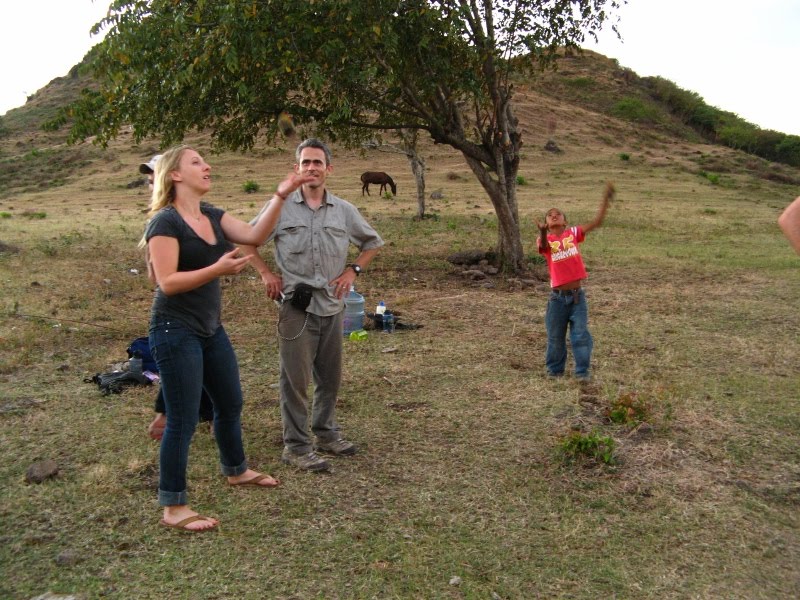
I, who like neither soccer nor baseball, spent the time juggling and teaching kids and other group members alike how to juggle.
The next day the group left and Kate and I stayed for an extra day of getting to know town. We took one picture with our host sister and host mama with Carly, Mike, and Chase from the group who stayed at the house with us. The Purisima alter is still up and going strong:

So while all of this was happening, the first full afternoon in el Jocote was scheduled for a 15-year birthday party, or QuinceaƱera. It's a lot like a wedding, but without the groom. It's a coming-of-age party common in Latin America, and hundreds of people were invited. They started arriving around noon in droves, both by horseback and by pickup truck (the first time we've ever seen more than a truck a day in town):

The Father, daughter, and damas and caballeros came down the hill in a giant pink procession:

And began with a full mass (they only get priest-led masses on special occasions here were there's no full-time priest):

We followed the procession back up the hill where the house and dirt yard was decked out in tents, pink balloons, pink cake, and pink frilly everything:

Behind the crowd you could see the parking lot on the hillside with grazing space included:

Then they blasted loud music from about 4 in the afternoon to about 2 in the morning as people danced--here is when we started leaving just after sunset:

The MBA student group came down for the party and we all had a good time. There was a little bit of awkwardness when we went out to dance because suddenly the entire attention of hundreds of eyes was on a handful of white people dancing in their village in the middle of nowhere. Some of the local drunk guys got a little too crazy with their interactions with us and we didn't stay on the dance floor for long, but it all made for good memories.

All in all, it was a nice trip to el Jocote, where we are really getting accustomed to the relaxing pace of life in the campo. We were sad to depart but we had some work to do back in town, namely chaperoning the student group to the beach the next day, so we weren't going reluctantly.