It's been a while since our last post, but we've been busy here. We had an office christmas party where our office staff from Managua went to the beach near San Juan del Sur. It was good for a place to play in the sand, swim in the waves, and get to know our co-workers better.
After a weekend trip to the nearby artisan community of Masaya, we started the week a little slow. I (Jeff) helped out with making some of the duct or flue parts for a clean cookstove project. The thing is, there are no ducts or flues here, since there are no heating systems, and everyone just cooks over open fires in their kitchens. We had to make the ducts and duct elbows from scratch, using sheet metal, tin snips, and a riveter. Other than that, we were low on useful work to do in the office, and after a few interesting but sickness-plagued visits to the rural communities, we had some discouraging feelings about fitting into the culture and figuring out what exactly we were doing here. That's an expected part of the trip, and so that nobody worries, things really changed the following week.
We talked to our boss here, the head of AsoFenix, who put us in charge of leading the environmental training sessions in our adoptive community of El Jocote. Before, he was planning on having an as-yet unnamed local lead the workshops and just have us help out. That may be where things were going downhill for us, because even though we liked the idea of an entirely Nicaraguan led project, we were dependent on someone who didn't exist yet. Organizing anything can take a while here, and it just wasn't a priority for the overworked AsoFenix staff. With us organizing the workshops, we'll still work with Nicaraguan presenters and just be leading activities and so on, but the responsibility of getting the workshops ready to go will be in our hands. We decided to override our frustrations and spend Christmas in El Jocote, to try again to get to know people, and to get ideas on the workshops we would be doing.
The bus trip down to the village on the 23rd--absolute madness! It was the last bus of that route before the holiday, so everybody was coming home for Christmas with lots of food and pinatas. We literally spent a couple hours on the bus sitting on top of sacks of rice and beans and rum piled up in the back and aisles of the bus. Once, a kid ran after the bus (remember, the bus can't quite do 10mph on the bumpy dirt roads here) with a pinata that fell off of the roof rack, which was also loaded over its capacity. Sorry, no pictures of that priceless incident.
The host family of Toño and Martha was set up with an elaborate altar of the immaculate conception scene, as they were going to host one of the last Purisima celebrations at their house in the new year (yes, the celebrations just keep going there).

I can summarize Christmas pretty quickly here. We told them about some of our traditions of Christmas Eve and Christmas, the families, the lights, the trees, and santa claus, who apparently doesn't come down to give presents to the kids in Nicaragua. They have a fake Christmas tree or two in town and a couple Santa pictures or statues on things, but they didn't really know what the story was with them. We asked them about their Christmas traditions. "Well," they said, "we eat beef." We tried to delve a little further into the details, when they explained that some people try to stay up until midnight (normal village bedtime is around 8 pm) with family and friends and maybe listen to music and dance a little, and they eat meat. Beef, that is. And that about explains our Christmas Eve. There was some grilled beef for lunch, and for dinner We went to a neighbor's house and had a type of beef stew with a big meaty beef bone in it to nibble on. And we were all so tired afterwards that we couldn't stay up until midnight. With the new moon and lack of electricity there, it was so dark and quiet in the village by 9pm that we couldn't imagine staying up three more hours, so we went to bed.
The deal about eating beef for christmas is that it takes quite a special occasion here in the village to slaughter a cow. Cows are huge animals, as you might recall, and there are at most a couple hundred people here way the heck out in the boonies with no refrigerators or means of delivery. A chicken is easy to prepare for a family dinner, but a cow takes coordination with the whole village. One person has to slaughter it and work out that very same day who in the village gets what parts of the cow. Then everybody basically has to eat a lot of beef within a day or two before it goes bad. So it's a big deal, and it's the freshest meat you can get.
We spent Christmas day and the next day meeting people in the village and in another village nearby. This was our job for the week. Meet people whom we will be working with, build trust, and continue get used to the Spanish over here where a lot of consonants get lost and there's a slew of words specific to Nicaragua and Central America that you don't learn in school. We met a lot of people and really had a great time getting to know the community and enjoying the amazing hospitality here. For example, after a late breakfast on the 27th, we followed it up with two early lunches, as each place we visited wanted to feed us. We had to start telling people that we had already eaten 3 meals and we really couldn't eat any more. Really. We also brought the photos from the wedding in El Balsamo, the neighboring town, to the family of the bride, and they insisted on me taking more photos of their family, so here's a pic of one of the daughters with two kids.

The littler kid on the left is actually the older one, but born as a 6-month preemie, which is extremely rare to survive here in Nicaragua.
Another thing we noticed this time were all the baby animals. Whether a bunch were born while we were gone, or whether they were running around under our radar, the place is full of them. Baby pigs, baby cows, baby chickens, baby dogs... It's amazing.


(From Kate: I named the mama chicken here "Chesterfield," as she's got the mutton-chop style beard that I associate with men in movies set in 1800s-1900s Britain. And Chesterfield Fried Chicken is common in West Virginian gas stations, I believe.)


Of course, not all the animals are cute. There are stingy wasps (seriously, though, doesn't this look like some sort of an alien cocoon?):

and stingy ants that live in the big spines of plants:

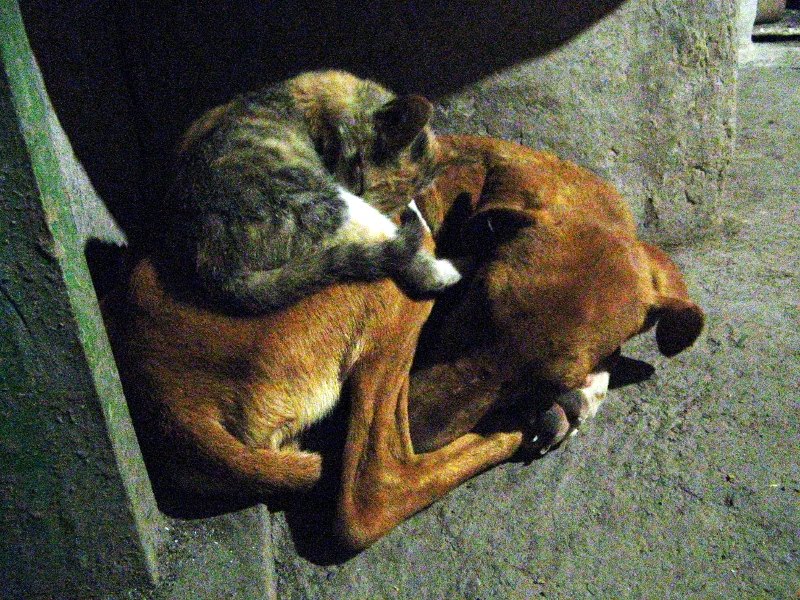
And honestly, you can't cuddle even the cutest dogs here, since they've all got fleas and who knows what else. But they're fun to watch, especially when they cuddle at night near the only warm spot, the cooking fire:

... or when there are cute kids like Dani around, too:

But of course, we did actually work. Although they may not know about Santa here, A truck arrived on Christmas day with presents for all (big excitement in the village when a truck or any vehicle arrives). It was filled with a couple tons of sand, a half ton of cement, chain link fence, and two concrete laundry washbasins.

Ready to implement the newly-arrived materials, AsoFenix came with a group from Portland to work on a couple projects in town for a couple days. The group, Havurah Shalom, was a Jewish congregation who raised an incredible amount of money for the AsoFenix projects, especially for El Jocote, making a lot of this work possible. We shared in the last Chanukah celebration with them and our host family and some neighbors. The host family commented to me that they felt like what Kate and I must have felt during some of their celebrations such as the Purisima--interesting and confusing to be in the middle of a different tradition and different language. But we all enjoyed that night as we sang to the light of a fully lit menorah on the kitchen table.

The next day was hard labor. Our mission was to build two patio gardens with greywater collection systems and strong fencing to keep out the ubiquitous rooting pigs and pecking chickens. There really are almost no fruits and vegetables in the village diet, so in addition to solving some greywater problems, the projects also hope to get some more vitamins into the local diet. The visiting group split in two so each half could work on the garden of one of the two houses to get them that day. Kate and I stuck with helping at the house of a villager that we knew well and who really needed the project. We began with building the fence.

We started with 30 meters of chain link fence and about 10 tree branches for posts. Without post hole diggers, we used spud bars, which are multi-purpose heavy metal bars with a chisel end. You spud around the post hole outline and the kids dig out the dirt on the inside.

The head of the household, Doña Ines, gave Kate a hat to wear because of the hot sun that day. She was so happy to be able to help out, and Kate loved the new trucker-style hat that she sported for the rest of the day. Once we got the fence put up, we all collected stones to line the fence bottom to keep critters out. Kate helped the local kids carry stones from the road:

And I spotted two little kids rolling one giant stone that looked like it weighed more than they did.

By the next day, plants had magically sprouted out of the ground (okay, they had been transplanted from their hiding spots), finally protected from the rooting and stomping beasts.

The second day, we built a shower base with a greywater pipe connected to the new washbasins they had outside. The pipe drains into a small concrete basin, which they will use to pull buckets of water for irrigating the garden. The old system (which I don't really have a good picture of) was just a shower base next to a pile of rocks for doing laundry, both of which drained over mud and into the river nearby. Kate got very ill that night from some gastrointestinal bug (as bad as her infamous food poisoning incident in South Africa, for those of you who know about that) and was out of service that day, so I also went to pay visits and show her pictures of our successes as the day progressed. Here's Toño and Juan Jose mixing up the concrete:

Our stone/gravel base for the shower pad:

Progress on digging the hole for the collection basin:


And the finished project

A note from Kate: I didn't get to help out the second day of construction. The night before, I was forced to worship what would have been a porcelain god if there were real toilets - i.e. I got some kind of bug that made me really sick. I spent a couple hours in the middle of the night out in the yard allowing my stomach to get rid of whatever was bothering it. I am eternally grateful to Jeff for being there to chase me around with towels, blankets, and toilet paper as the need arose. I spent the next day in bed, and couldn't eat much - least of which the rice and beans that were my last meal before becoming sick. Now, a few days later, I've got my strength and appetite back, but rice and beans are not yet appealing. We'll be heading back to the village in just under a week, so I'm hoping the feeling passes soon. It was heartening to have several of the folks we've recently met, and a few we haven't yet met but who have seen us around town, stop by my room and check in on me. During Jeff's noontime visit, a crowd of kids accompanied him to see if I was okay. I'm also grateful that I was really sick at night, so none of my visitors had to see that.
With the successes that we did have with the projects and meeting people in the village, and with a sudden feeling of almost too much to get done in the next few weeks, we're feeling much better about continuing our work here. We're both impressed with how AsoFenix plans and implements its projects, and we're really happy to be a useful part of that. Plus, we're finally realizing that our Spanish is improving to true conversational level, even if "campo Spanish" (the very different version they speak in the village) is still tough.
Now we're in Granada for New Year's. The transition straight from a week of village life to the super-touristy Disney-style Nicaragua of Granada was a little shocking at first, but we're adjusting quickly. The details of our trip here will be the subject of another post when we're "home" to Managua. For now, we wish you all a happy New Year, and lots of love.


 (OMG Gringos!)
 with crazy looking drinks for sale:
 so that made us feel better (the reality of it all, not the drinks - no way were we drinking something with those colors). We found our way to the beach of Lake Nicaragua, which was not super touristy:
 It was, in fact, really buggy, and the waves were bringing in pretty dirty water. So Granada was beginning to feel a little less Disney-ish to us.

 checking out the colonial houses from the outside, both upkept and not.
 Like most towns around here, Granada has lots of pretty churches:


 the last of which had its belltower open:
 The views from up there were stunning:

 ...and the staircase was something else:

 But Granadians know their fixer-uppers:
 Even the government gets in on it, as in the case of the old hospital that is crumbling, but will get a facelift (more pictures of this later):


 but we like to walk and sweat and sweat and walk.

 A parade came by with an effigy of an old man, signifying the old year, that they burn at midnight:
 And of course, at midnight, there were fireworks. This time, though, they weren't just the noisy ones - pretty ones were included!